




 Upcoming Events
 Event Series
 On-Demand Events


Why Mindshare Will Define B2B Marketing Success in 2026

Table of Contents
Maximize Your Marketing ROI
Join 10,000 other marketers already getting the best tips on running engaging events that boost pipeline and create raving fans.
Think of inbound marketing, and HubSpot likely comes to mind. The company has become practically synonymous with the concept, as evidenced by its flagship annual event, INBOUND. Same goes for Slack and asynchronous communication. So many companies use Slack that it's become a noun and a verb.
This phenomenon goes beyond standard brand recognition. It's mindshare, the intangible magic that makes a brand the automatic go-to choice for decision makers when it's time to buy.
By 2026, brands dominating aren't outspending on ads. They're the ones buyers discover through AI search, see in communities, watch on video, and remember when it matters.
This is mindshare separating leaders from everyone fighting for scraps.
Today, we'll walk through why mindshare has become more achievable than ever in 2026, and how systematic content engines powered by agentic AI are making it possible for teams of any size to compete.
What is mindshare marketing?
Mindshare represents the level of customer consciousness you "own" in your industry. While traditional brand awareness references whether people know that you exist, mindshare is interested in where you rank on the leaderboard when it's time to make a purchase.
Sure, being on the list is great, but being the only one on the shortlist? Even better.
Mindshare can't be achieved through brute force — you can't just pour a ton of money into paid ads and expect your reputation to rise. You'll need to think strategically about ways you can enter relevant conversations and engage with people. This might look like participating in audience communities or creating user-generated videos that your customers can share with their networks.
Videos are a natural vehicle for mindshare marketing. Video is projected to account for 82% of all internet traffic this year, with 91% of businesses now using video as a core marketing tool. Video isn't supplementary content at this point; it's the primary way buyers consume information, evaluate solutions, and build trust with brands.
How is Mindshare different from other approaches?
Here's a quick overview of how mindshare differs from traditional approaches like lead generation and demand generation:
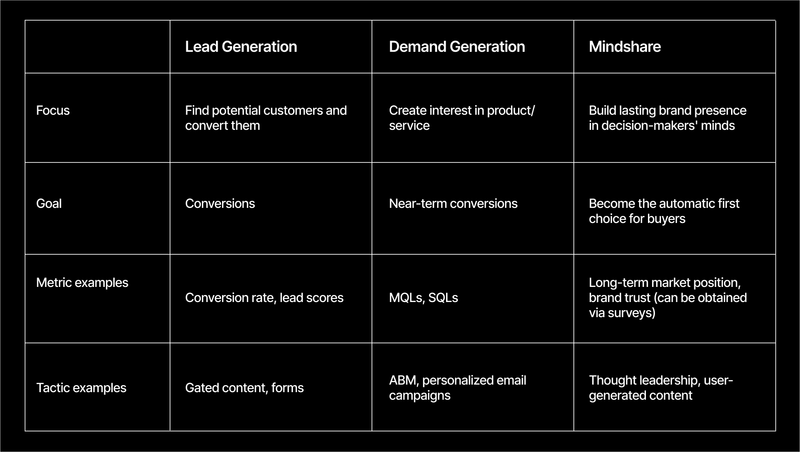
Note that while much of marketing prioritizes short-term results, mindshare is in it for the long-haul, aiming for the enviable #1 spot across an industry category. This isn't to say that the other approaches don't still matter or contribute to revenue goals, but mindshare takes a more holistic view that's needed given today's changing buying landscape.
In 2026, mindshare is created by a systematic, AI-fueled engine that turns each piece of content into dozens of touchpoints, all while maintaining your authentic brand voice. Teams that once couldn't compete with enterprise budgets now have access to agentic tools that democratize content production — so if you've been waiting to start your video efforts in earnest, now's the time to start.
Why mindshare matters in 2026
Speaking of the buying landscape … here are some key reasons why mindshare will help you succeed this year:
Shifting buyer journeys and trust requirements
According to Forrester's 2023 Business Trust Survey, 77% of purchase influencers consider brand awareness when deciding whether to trust your company. We also know that buyers are almost 70% of the way through their buying journey before they ever make contact with you.
Finally, companies like Databox have found that the average buying cycle is at least 3-4 months, with deals taking progressively longer as the associated dollar value of the contract goes up.
Because the B2B buying cycle is lengthy and buyers largely do their own research before ever reaching out — often on AI search engines like ChatGPT and Perplexity — you'll have to create substantive, well-structured, consistent content to show up in those results.
You also need to reach more people than you did in the past. B2B buying decisions are often influenced by many stakeholders, which means you'll need to have that trust and brand recognition with all (or at least most) of them.
Mindshare helps you get there, using content like thought leadership and emotionally resonant videos to make sure that people meet you, trust you, and like you. Mindshare is the way you become the default choice in your category, the top brand that buyers want to go with when it's time.
Increasing competition requires differentiation to stand out
There are more than three million B2B companies in the U.S. alone. If you're in the B2B tech space specifically, you may have felt a sense of crowding as new players pop up and established companies expand into new lines of business.
Standing out right now requires more than just a solid product; you need to own something within your category. Most solutions solve problems similarly, so differentiate the way you show up.
Look at Gong, a company that pioneered (and now owns) the concept of "revenue intelligence." Gong's founder noticed that sales numbers weren't always proportional to key metrics, and he set out to discover why and resolve the discrepancy. Now, if you want to get serious about revenue, Gong's probably the first brand you consider.
You don't have to create something totally new, either. Mindshare also works if you zero in on the messages you want to own and then focus on amplifying them as much as possible. Box 10x'd their video output using Content Lab. Uber for Business increased pipeline by 25% through video-led campaigns. Hootsuite grew organic traffic by 150% by repurposing webinar content into blogs and video clips. Thanks to AI, that level of production is available to everyone.
Digital and community influence
Most of us are on more than one social platform, but the most influential conversations are happening in places you can't easily track: private Slack channels, Discord servers, LinkedIN DMs.
According to ReferralRock, 84% of B2B decision-makers start their buying process with a referral — making it critical to reach the person doing the referring! Referrals are also four times as likely to make a purchase and have a 16% higher lifetime value — and a referral is a much easier deal to close than a cold lead or prospect.
This is why being involved in user communities, sharing your expertise on LinkedIn, and partnering with customers and experts to broadcast their stories about your company is so important. When customers become advocates and share your content to their networks, your reach multiples exponentially.
Here are some ways to engage your customers as brand advocates:
- Video testimonials: Capture these during QBRs and other events
- Customer-led webinars
- Community contributions: Let folks speak at your events and share their stories
- User-generated content: Enable creation, not just consumption!
A concrete example: Board of Innovation (BOI), an innovative AI consultancy, selected Goldcast Events to host a virtual summit with 10K+ attendees. BOI also relied on Goldcast Content Lab to quickly repurpose event recordings into clips for YouTube, social media, and elsewhere.
After the summit, we interviewed BOI about their experience. We then turned that interview into a case study, blog content, video snippets, social posts, and other assets we can use to promote on our own channels. We also sent all of the videos and other materials to BOI so they can post it to their network as well, dramatically increasing our reach.
See How Content Lab Builds Mindshare at Scale
Turn one hour of video into 15+ clips, blogs, and social posts in minutes. Upload your content free and see what's possible via AI-enabled repurposing.
The 2026 mindshare execution framework
The following five strategies work together to build mindshare:
Strategy #1: Event-driven content engine
The most efficient path to mindshare in 2026 is creating recurring event series that feed your content calendar for months. One monthly series becomes 12 events per year. After each event, a tool like Content Lab automatically produces 15+ video clips, 1+ blog posts, dozens of social posts, and email nurture content.
Let's do the math: 12 events → 180+ clips and 12+ blog posts without manually editing a single frame. Platforms like Goldcast Events capture high-quality recordings, Recording Studio creates polished, podcast-style content, and Content Lab identifies key moments, generates clips with your branding, and drafts accompanying written content — all in minutes, not weeks.
Strategy #2: Thought leadership that actually leads
People want to hear authentic POVs from people who've actually done the work: founders with contrarian takes on industry trends, customer success teams sharing wins, product leaders solving hard problems, and community experts offering insights you can't find anywhere else.
Video interviews, panel discussions, and fireside chats capture this authenticity in ways written content simply can't match. The key is consistency — publishing regularly, not sporadically — and using agentic tools to repurpose every conversation into multiple formats so your message reaches people where they actually consume content.
Strategy #3: Strategic partnerships and co-marketing
Referrals are powerful, but you can't build mindshare alone. Look for strategic partners that can boost your reach and credibility. Start by combing through your customer database; you likely have fans who'd be thrilled to co-market with you.
Avoid partnering with direct competitors where you'll split your audience. Instead, find industry leaders, influencers, and complementary service providers that help you reach new markets while potentially strengthening both offerings.
The AI Marketing Alliance is a strong example. Goldcast co-founded this community alongside 6sense and Intelligent Demand, giving all sponsors access to marketing leaders through virtual events and outreach efforts. Expert guests amplify reach further by sharing video clips and content after each event, multiplying visibility across networks.
Strategy #4: Brand consistency at scale
Your audience encounters hundreds of content pieces each day. Make it easy for them to recognize you by staying consistent with your branding, logos, messaging, and voice. You can adapt slightly for different platforms, but it should never be unclear that it's you behind the content.
Consistency also fosters trust, which we know is critical to winning business. This is where Brand Voice features in tools like Content Lab become invaluable — you can develop and refine your brand tone, apply different voices to different thought leaders, and ensure every piece of AI-generated content still sounds authentically like you.
Strategy #5: Community as a competitive moat
Communities create mindshare that competitors can't easily replicate. This is the work we do to build communities like Events Marketers Club and AI Marketing Alliance, but you don't have to start something net-new. You can also create customer Slack channels or co-host a gathering or event.
Communities aren't just marketing channels; they're sources of feedback, co-creation opportunities, and proof that your brand matters to people beyond the transaction.
Avoid these common mindshare mistakes
Mindshare isn't just mind over matter — you can't will your way there, and you also can't churn out a ton of content in the short-term and check mindshare off your list. Avoid these big mistakes as you begin.
DON'T treat AI as an output generator instead of a workflow enabler
The trap many teams fall into is using AI to create more generic content, but faster. The real power of agentic AI is handling tedious, time-consuming work—clipping videos, formatting content, applying brand guidelines—so humans can focus on strategy, messaging, and authentic storytelling.
Teams winning with mindshare use agentic AI to scale quality, not quantity. They let AI handle the mechanical work while maintaining full control over voice, positioning, and what actually gets published.
DON'T oversaturate the market with content
With AI tools at your fingertips, it's tempting to think quadrupling content production is the answer. This usually backfires because it dilutes your brand voice and risks annoying your audience.
Start slow and steady. Focus on content that genuinely shapes how people think and adds substantive value to conversations. Monitor what people are talking about on social media, then share data-backed insights or host events that give people space to discuss important topics together. Quality and consistency beat volume every single time.
DON'T underestimate the long-term investment
Mindshare is a marathon, not a sprint. Results take time, so don't get derailed by short-term KPIs. Be intentional with your strategy, and remind yourself that this is about overall brand-building, not immediate financial impact.
HubSpot is almost 20 years old and valued at $20 billion — but they didn't get there overnight. It took years of consistent brand building, community development, technological innovation, and thought leadership. The same trajectory applies to any B2B giant you admire. Mindshare takes time, but the compounding returns are worth it.
DON'T think you can't measure progress
Although we can't use traditional KPIs like deals won or immediate revenue to measure mindshare, we can track more holistic metrics:
- Content engagement: Are people commenting, sharing, and discussing your posts? Are overall impressions growing?
- Event performance: How many community members attend your events? What feedback do you get in post-event surveys?
- Video performance: Are your key topic videos being watched? For how long? Who's watching and sharing?
- AI search citations: Are you being mentioned in ChatGPT or Perplexity responses when people ask about your category?
- Name drops: Do people mention they've heard about you before you're aware of them? Are you being recognized in industry speeches or included in round-up lists?
- Partner invitations: Are more brands asking to collaborate with you?
- Raving fans: When customers start sharing their stories unprompted, you're moving in the right direction.
You may identify other ways to measure progress, depending on your specific strategy. We'd love to hear how you go about tracking mindshare once you've got it set up!
Make mindshare your 2026 priority
As we move deeper into 2026, we urge you to focus on building strong mindshare. Competition in the B2B space is only intensifying, and brand trust and recognition will be the deciding factors in winning buyers over.
The good news? Mindshare is more achievable than ever. Agentic AI handles the heavy lifting of content production. Video hubs sync to CRMs so you can take personalized follow-up actions. Platforms capture high-definition recordings instantly. Tools repurpose content in seconds instead of weeks. Communities grow organically when you provide consistent value.
Start by auditing your current position. Be honest: How deeply does your brand resonate with the decision-makers you most want to reach? How effective is your content? How strong is the community you've created? How do you stack up against competitors? The answers to these questions provide guidance on where to focus your mindshare efforts.
From there, establish goals around creating an event-driven content engine. Talk to your team and your C-suite, and get everyone aligned on your mindshare strategy. Look for integrated platforms that let you capture, repurpose, distribute, and measure content systematically, and then commit to consistency. Regularly publish content, connect with your audience frequently, and work to nurture key partnerships and relationships.
The proactive steps you take right now will pay massive mindshare dividends when it comes to market perception and brand competitiveness.
Build Mindshare with Goldcast's Complete Platform
From Events and Recording Studio to Content Lab and Video Hubs, everything in Goldcast works together to create systematic content engines, building mindshare over time. See how the complete platform works now!
Mindshare FAQs
How has mindshare building changed from 2025 to 2026?
The fundamental principles remain the same — consistency, authenticity, and strategic visibility — but the execution has changed. In 2026, agentic AI workflows automate the tedious parts of content creation (clipping, formatting, captioning, drafting), while platforms provide integrated analytics that connect content consumption directly to pipeline. The barrier to entry has dropped dramatically.
Can small teams really compete against enterprise marketing budgets?
Absolutely! The competitive advantage has shifted from budget size to system efficiency. A three-person team using an integrated platform with agentic workflows can produce more consistent, higher-quality content than a ten-person team using disconnected tools and manual processes.
Is content quantity or consistency more important for mindshare?
Consistency wins. Publishing predictably (whether that's weekly, bi-weekly, or monthly) is key. A monthly event series that runs for a year creates more mindshare than a dozen random webinars scattered across the calendar. Quality matters too, but consistency is what keeps you top of mind when buying decisions happen months after someone first discovers you.
How do I prove mindshare ROI to executives who want immediate revenue metrics?
Mindshare metrics require looking beyond last-touch attribution. Track account-level video engagement synced to your CRM; this shows which target accounts are consuming your content before they enter the sales pipeline.
Also monitor AI search citations, branded search volume growth, event attendance trends, and community engagement. Then connect these leading indicators to pipeline velocity: accounts that engage with content typically move faster through sales cycles and close at higher rates. The ROI story is there; it just requires telling it through a different lens.
What's the role of video vs written content in building mindshare?
Video is the primary medium. 82% of internet traffic in 2026 is video, and it's how most buyers prefer to consume information. But written content plays a critical supporting role! Blogs boost SEO and help AI search engines understand your expertise, social posts drive discovery and sharing, and email content nurtures relationships.
The ideal approach is multimodal: Capture high-quality video (events, interviews, podcasts), then use agentic tools to create written assets from that same source material. This ensures your message reaches people regardless of their preferences.
Transform Your Video Marketing with AI

Stay In Touch
Platform
Resources
© 2026 Copyright Goldcast, Inc. All rights reserved.